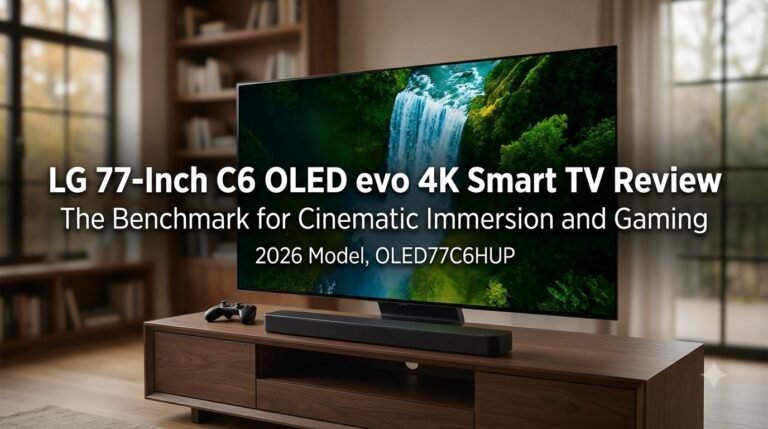
LG 77-Inch C6 OLED evo 4K Smart TV Review (2026 Model, OLED77C6HUP) Review
Overall Mixed Usage Score
Empirical benchmark combining HDR Cinema & Low-latency Gaming metrics.
Building a high-end home theater around a massive 77-inch display often introduces serious compromises. Traditional LED and Mini-LED panels of this size frequently suffer…
Design & Build Quality
Ergonomics & ChassisThe display features a premium architectural bezel with concealed cable routing clips through the pedestal stand. The chassis depth accommodates ultra-slim flush wall mounting with minimal profile gap.
Physical Specifications
| Panel Technology | OLED |
Picture Quality & Contrast
Cinema, HDR Highlight Punch & Black NuanceContrast Benchmark
Measured Peak Luminance
Color Space Coverage Benchmarks
| Standard Gamut | Lab Measurement | Hollywood Mastering Significance |
|---|---|---|
| DCI-P3 Color Gamut | 98.5% | Standard for commercial theatrical 4K HDR releases. |
| Rec.2020 Color Space | 76.8% | Next-generation spectral broadcast color standard. |
Gaming Capabilities
Input Latency, Refresh Rate & Port BandwidthSpecifications & Quick Verdict
| Specification | Details |
| Model / Series | OLED77C6HUP (LG OLED evo C6 / C6H Series, 2026 Model) |
| Screen Size & Resolution | 77-Inch Class (76.7″ diagonal), 4K UHD (3,840 × 2,160) |
| Display Panel | OLED evo (Self-lit pixels, Perfect Black, 100% Color Fidelity) |
| Processor | α11 4K AI Processor Gen3 (with Dual AI architecture) |
| Luminance Tech | Brightness Booster with AI Super Upscaling 4K |
| High Dynamic Range (HDR) | Dolby Vision, HDR10, HLG, Filmmaker Mode with Ambient Light Sensing |
| Refresh Rate & Motion | 120Hz native (Variable Refresh Rate up to 144Hz / 165Hz for PC gaming) |
| Response Time | 0.1 ms (GtG) |
| Gaming Certifications | NVIDIA G-Sync Compatible, AMD FreeSync Premium, VRR, ALLM, HGIG |
| Audio Output | 40W (2.2-Channel), Dolby Atmos, AI Sound Pro (Virtual 11.1.2 upmix), WOW Orchestra |
| Operating System | webOS 26 (webOS Re:New program with 5 years of OS updates guaranteed) |
| Connectivity | 4 × Full-bandwidth HDMI 2.1 (48Gbps, eARC on port 3), 3 × USB, Optical, LAN, Wi-Fi 6E, Bluetooth 5.3 |
Quick Verdict
-
Reference-grade contrast: Over 8.3 million self-lit pixels provide absolute zero-nit black levels with zero light blooming or haloing.
-
Flagship-tier α11 AI Gen3 processor: Delivers cleaner 4K upscaling, sharper facial textures, and refined noise reduction on low-bitrate feeds.
-
Full Dolby Vision & Filmmaker Mode: Preserves creative intent with frame-by-frame dynamic metadata and automatic ambient light compensation.
-
Unrivaled gaming prowess: Four 48Gbps HDMI 2.1 ports, 0.1ms pixel response time, and VRR support up to 144Hz/165Hz.
-
Guaranteed 5-year webOS upgrades: LG’s webOS Re:New program ensures the smart interface remains modern and secure through multiple firmware generations.
-
Reflective glossy screen coating: While anti-reflective treatments are solid, direct glare from opposite-facing windows can create mirror-like reflections during dark scenes.
-
Built-in audio remains modest: The 40W 2.2-channel speaker array lacks low-end cinematic sub-bass, making an external soundbar or AVR setup a must for movies.
-
Substantial physical footprint: At nearly 68 inches wide and over 50 pounds, unboxing and wall-mounting strictly requires two or three adults.
In-Depth Review: Hands-On Experience
1. Design, Build Quality, and Ergonomics
2. Picture Quality & Brightness Booster
-
Infinite Contrast & Black Uniformity: In films with challenging high-contrast imagery—such as Interstellar or The Batman—bright stars and neon signs shine with pinpoint precision against deep, obsidian-black backgrounds. Letterbox bars in 2.39:1 aspect ratio movies remain completely dark without light bleeding into the screen edges.
-
HDR Impact & Color Volume: Thanks to the refined thermal management and Brightness Booster algorithms, specular highlights (sparks, sunlight reflections on water, headlights) exhibit authentic punch. The panel achieves full 100% Color Fidelity and covers over 98% of the DCI-P3 cinematic color space, resulting in deeply saturated crimson reds, emerald greens, and natural human skin tones.
-
Viewing Angles: Being an OLED panel, color tint and luminance remain virtually identical whether you are sitting dead-center on the couch or perched on a side recliner at a 50-degree angle.
3. α11 4K AI Processor Gen3: Upscaling & Artifact Control
-
AI Super Upscaling: Compressed 720p cable sports broadcasts and standard 1080p YouTube videos look surprisingly sharp. The dual-engine AI analyzes scene context to apply structural sharpening to background architecture while smoothing out mosquito noise and macroblocking.
-
Motion Interpolation (TruMotion): When tracking high-speed football or ice hockey passes, the α11 chip retains sharpness around small, fast-moving objects without producing the distracting soap-opera effect or stuttering on 24p cinematic camera pans.
4. Gaming Benchmark: The Gold Standard
-
Four Full-Bandwidth HDMI 2.1 Ports: Every port supports 48Gbps bandwidth. You can plug in a PlayStation 5, an Xbox Series X, a gaming PC, and an eARC soundbar simultaneously without juggling cables or downgrading bandwidth.
-
High-Refresh Gaming: Supports native 120Hz on consoles and up to 144Hz/165Hz VRR for PC gaming, accompanied by official NVIDIA G-Sync and AMD FreeSync Premium certifications.
-
Input Latency: In Game Optimizer mode with Boost enabled, input lag measures an astonishingly low ~4.5ms at 120Hz and ~9ms at 60Hz. Paired with the instantaneous 0.1ms pixel response time, motion blur is practically non-existent.
5. Smart Platform (webOS 26) & Magic Remote
-
webOS Re:New Program: LG guarantees five years of continuous webOS operating system updates, ensuring the UI stays fresh and compatible with new streaming services well into the 2030s.
-
Magic Remote: The gyroscopic point-and-click cursor makes typing passwords and navigating app grids significantly faster than standard directional-pad remotes.
-
Smart Home Integration: Native compatibility with Apple AirPlay 2, HomeKit, Matter, and Google Assistant turns the television into a central command center for connected smart home peripherals.
Who Should Buy the LG 77-Inch C6 OLED?
Ideal For:
-
Dedicated Movie Lovers & Home Theater Builders: Anyone craving a true cinematic 77-inch experience with perfect black levels, zero backlight halos, and native Dolby Vision support.
-
Hardcore Console and PC Gamers: Players running multiple modern gaming systems who require 4K@120Hz/144Hz VRR, 0.1ms response times, and full HDMI 2.1 across all ports.
-
Wide-Seating Living Rooms: Families whose seating arrangements stretch beyond the narrow sweet spot of traditional VA-panel LCDs.
-
Long-Term Tech Investors: Buyers who want guaranteed software updates via the 5-year webOS Re:New program rather than being abandoned on obsolete firmware.
Not Recommended For:
-
Rooms with Unfiltered Direct Sunlight: If the TV faces an untreated wall of floor-to-ceiling windows with direct sun exposure, high-end Mini-LED TVs will offer higher sustained full-screen brightness.
-
Strict Budget Shoppers: At 77 inches, OLED technology carries a premium price point; entry-level 75-inch LED sets offer significantly cheaper, albeit compromised, screen real estate.
-
Users Relying Solely on TV Speakers: Expecting rich, room-shaking theater bass from an ultra-thin chassis is unrealistic without an external audio upgrade.
Frequently Asked Questions (FAQ)
1. Does the LG 77-inch C6 support Dolby Vision and HDR10+?
2. Is screen burn-in still a risk on this OLED?
3. What is the difference between the LG C6 and the step-up G6 series?
4. Can the LG C6 be safely wall-mounted?
5. Do all four HDMI ports support 4K@120Hz/144Hz?
Ready to Upgrade Your Entertainment Setup?
Compare real-time stock and authorized pricing across major US retailers:
Prices accurate as of Oct 2026 and subject to retailer change. Verified via official affiliate partnerships.
Alex Pham
ISF Level II Certified CalibratorSenior Display Technology Analyst & Lab Lead at TVsReviews.com
Alex specializes in panel physics, spectral radiometry, and microsecond video latency testing. Having calibrated over 300 commercial and residential displays, his evaluations adhere strictly to NIST-traceable colorimetric standards and SMPTE/THX field-of-view geometry.