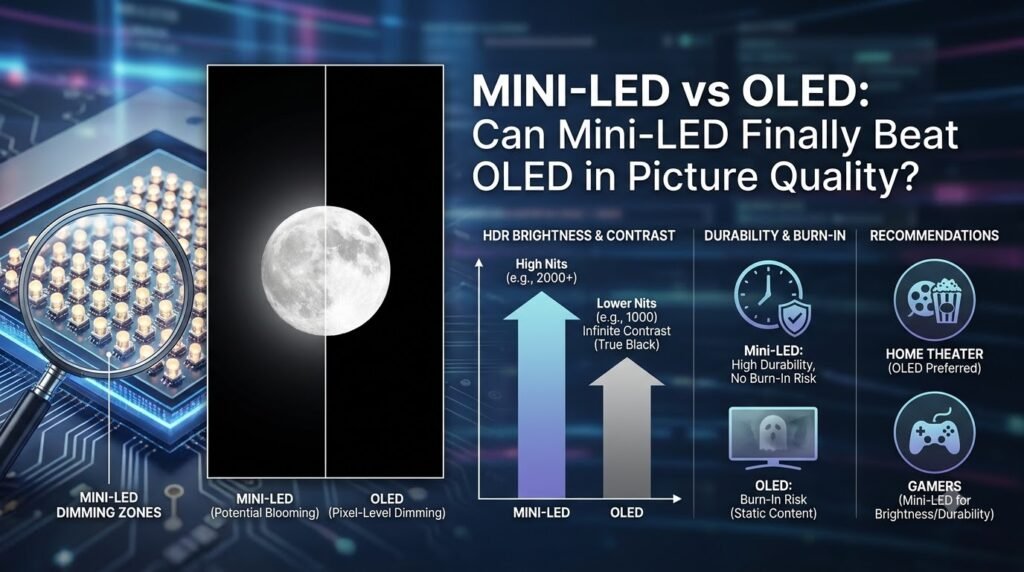
Mini-LED vs OLED: Can Mini-LED Finally Beat OLED in Picture Quality?
For the past several years, anyone searching for the pinnacle of television picture quality was steered toward a single answer: OLED. With its self-emissive pixels and ability to produce absolute black, OLED quickly became the benchmark against which all other displays were judged.
However, display technology never stands still. Enter Mini-LED—the biggest evolutionary leap in backlighting since LED-backlit LCDs replaced CCFL tubes decades ago. With thousands of microscopic diodes packed behind the screen and sophisticated local dimming algorithms, today’s flagship Mini-LED TVs promise to deliver the deep black levels of OLED while producing two to three times the peak brightness.
If you are stuck weighing mini led vs oled for your next major home theater upgrade, you are likely wrestling with tough questions: Does Mini-LED still suffer from distracting halos in dark rooms? Can OLED hold its own in a sunlit living room? And has Mini-LED finally closed the gap enough to dethrone OLED as the undisputed picture quality king?
In this hands-on breakdown, we will examine the real-world performance differences, test their limits across HDR movies and high-framerate gaming, and help you determine which panel truly deserves a place on your wall.
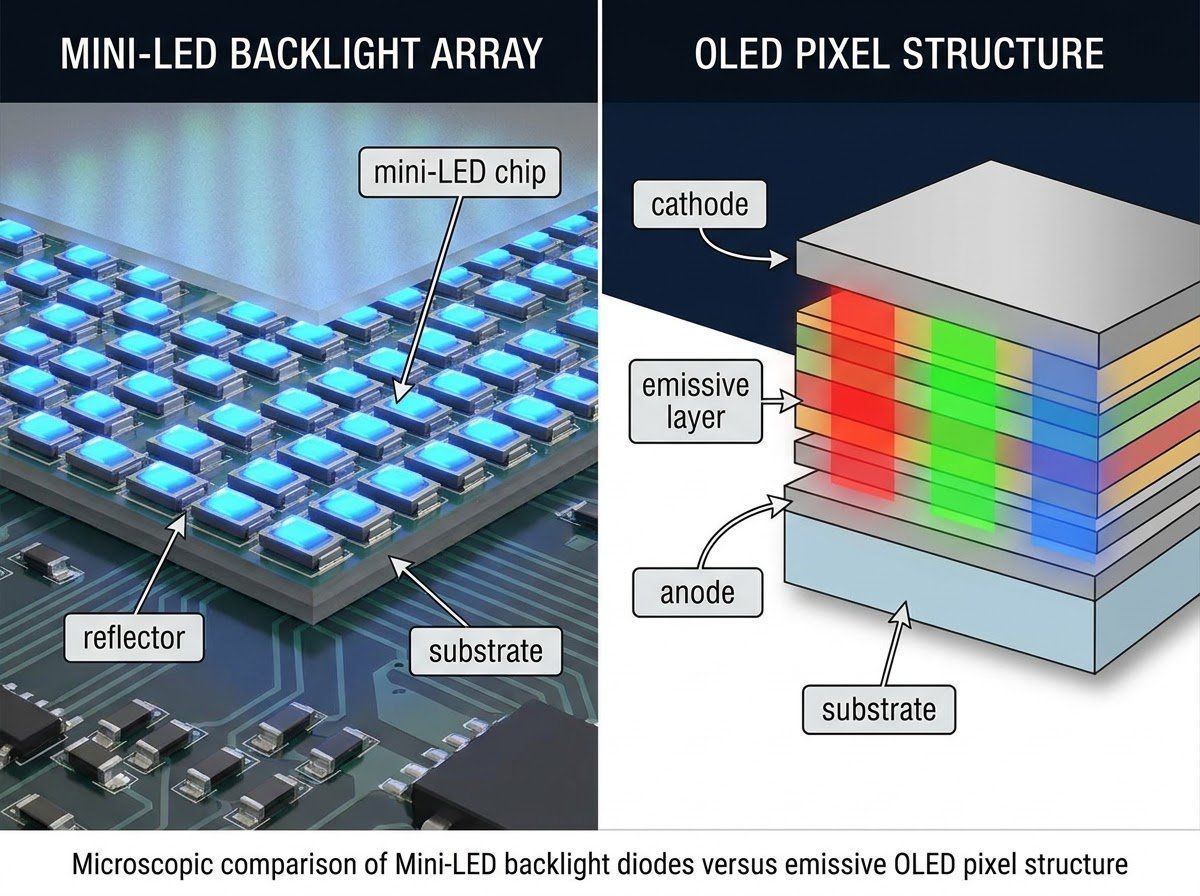
What Is Mini-LED, and How Does It Differ from Traditional LED?
To understand how Mini-LED challenges OLED, we first need to look at what changed under the hood compared to conventional LED TVs.
A standard Full-Array Local Dimming (FALD) LED television uses roughly a few hundred light-emitting diodes distributed across the back of the panel, grouped into anywhere from 32 to 300 dimming zones. Because each zone covers a relatively large physical area, subtle light control is difficult.
Mini-LED replaces those bulky LEDs with diodes that are roughly one-fortieth the size of standard LEDs (around 100 to 200 micrometers across). Because the diodes are so tiny:
-
Denser Diode Packaging: Manufacturers can pack tens of thousands of individual Mini-LEDs into the same chassis.
-
Exponentially More Dimming Zones: Instead of a few hundred zones, premium Mini-LED displays feature anywhere from 1,000 to over 5,000 individually controlled local dimming zones.
-
Slimmer Chassis Profile: Smaller diodes allow the backlight layer to sit closer to the LCD diffuser, creating screens nearly as sleek and thin as OLED panels.
The Blooming Battleground: Halo Effects on Mini-LED vs. OLED
The fundamental dividing line between mini led vs oled comes down to light containment.
The OLED Advantage: Pixel-Level Control
OLED remains the gold standard in light isolation because it is emissive. On a 4K OLED panel, every single pixel out of the 8.29 million functions as its own independent dimming zone. When a white star appears against the deep void of space in Interstellar, the pixels displaying the star illuminate at full brightness, while the adjacent pixels remain turned off. The transition from pure light to absolute black occurs across a microscopic fraction of a millimeter.
The Mini-LED Reality: Algorithmic Dimming and Blooming
Mini-LED has dramatically reduced the coarse “light bleed” of older LCDs, but it remains a transmissive technology. Even an exceptional Mini-LED TV with 2,000 local dimming zones must use one single zone to light an area containing several thousand pixels.
When a bright, isolated object appears on a dark background—such as white subtitles during a moody movie scene or a loading icon—the TV must turn on the backlight zone behind it. This causes a faint haze of spilled light known as blooming or the halo effect.
While top-tier image processors from Sony, Samsung, and Hisense use clever machine-learning algorithms to suppress blooming by slightly dimming highlight edges, blooming has not been eliminated. In a pitch-black room, sensitive viewers will still notice subtle halos around high-contrast edges on Mini-LED sets.
Winner: OLED.
To see how older LED backlighting compares to these newer standards, explore our guide on Full Array Local Dimming (FALD) and Backlight Types.
HDR Impact and Contrast: Peak Nits vs. Shadow Precision
Contrast is what gives images three-dimensional depth, but High Dynamic Range (HDR) also demands high luminance to recreate natural specular highlights—like glinting sunlight off chrome or blinding explosions.
Peak Brightness: Mini-LED Dominates the Spec Sheet
This is where Mini-LED flexes its hardware muscles:
-
Mini-LED Performance: Flagship Mini-LED televisions effortlessly push sustained brightness levels between 2,000 and 4,000 nits, with some newer models breaking beyond 5,000 nits on small HDR windows. Even across a 100% full-white screen, a Mini-LED display can sustain 600 to 800+ nits. This makes them ideal for brightly lit living rooms with expansive windows.
-
OLED Constraints: While second-generation QD-OLED and Micro Lens Array (MLA) WOLED panels can now flash localized 10% highlights at 1,300 to 1,500 nits, their full-screen white brightness drops significantly (often hovering around 200–250 nits) due to aggressive Automatic Brightness Limiter (ABL) software designed to prevent panel overheating.
Perceived Contrast: The Dark Room Equalizer
In a dark room, our eyes adjust to lower ambient light levels. Because OLED hits a true black floor of 0.000 nits, its perceived contrast often feels richer and punchier than a 3,000-nit Mini-LED that elevates shadow details to a very dark gray.
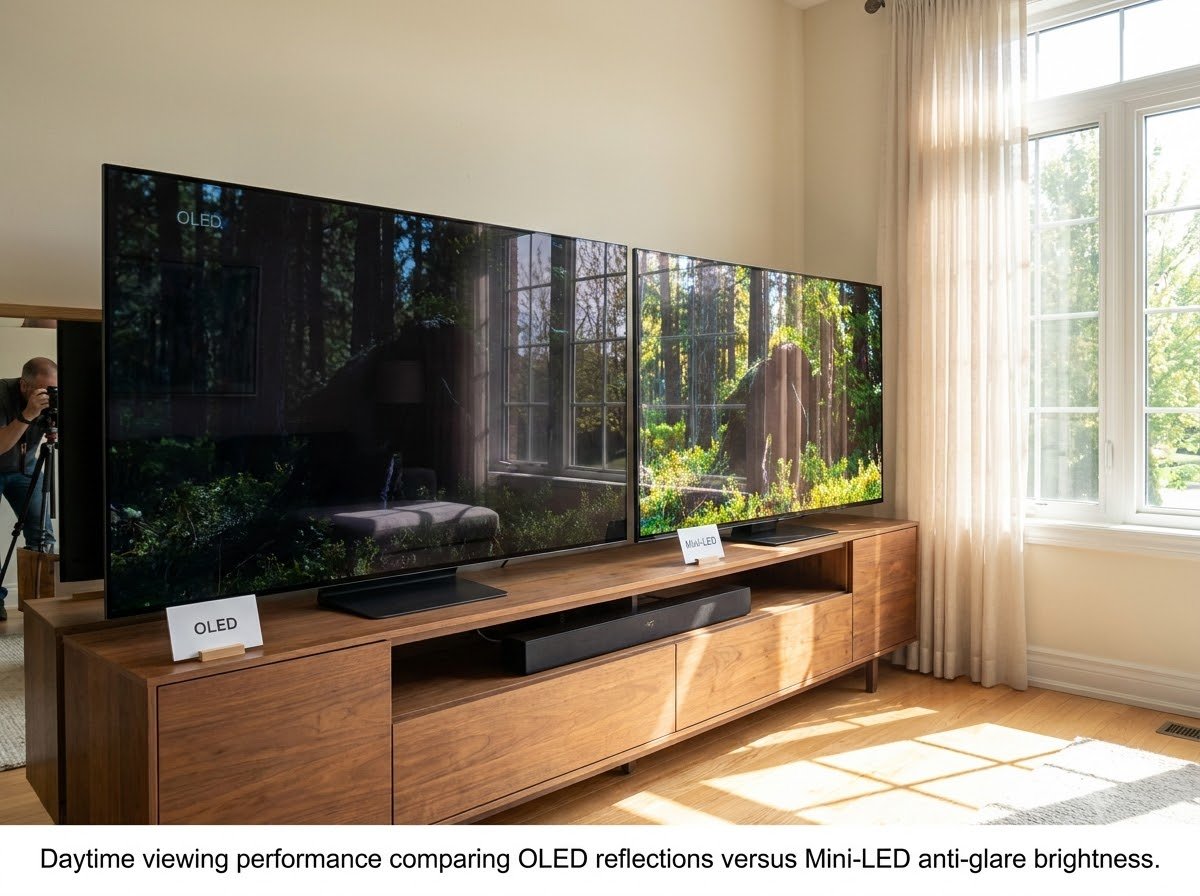
However, step into a room with daylight pouring in, and ambient reflections will wash out OLED blacks while Mini-LED cuts right through the glare.
Winner:
-
Dark room viewing: OLED
-
Bright room viewing: Mini-LED
Durability, Longevity, and Burn-in Resistance
If you plan to keep your television for 7 to 10 years, panel longevity should be near the top of your checklist.
-
OLED: Modern OLED panels incorporate impressive preventive features, including heatsinks, pixel refreshing cycles, and logo dimming. For typical, mixed use (movies, streaming series, occasional gaming), burn-in is very rare today. However, because organic light-emitting compounds degrade with thermal stress and cumulative use, leaving static channels (like CNBC or CNN) or desktop user interfaces on for 10+ hours a day remains a calculated risk.
-
Mini-LED: Mini-LED panels rely on inorganic gallium nitride (GaN) LEDs and quantum dot crystals. They are physically immune to permanent image retention and burn-in. You can pause a pause menu indefinitely or use the display as an all-day PC monitor without concern.
Winner: Mini-LED.
Head-to-Head Specification Breakdown
| Performance Metric | Mini-LED (Flagship) | OLED (WOLED / QD-OLED) | Clear Advantage |
| Dimming Precision | 1,000 to 5,000+ zones | 8,290,000+ independent pixels | OLED |
| Absolute Black Level | Near-Black (0.001 – 0.005 nits) | Absolute Zero (0.000 nits) | OLED |
| Peak HDR Brightness | 2,000 – 4,000+ nits | 800 – 1,500 nits | Mini-LED |
| Off-Axis Viewing Angles | Moderate color shifting (>30°) | Flawless up to ~70° | OLED |
| Screen Glare Handling | Excellent (Overpowers light) | Good (Relies on anti-reflective film) | Mini-LED |
| Burn-in Vulnerability | Zero | Low to Moderate (Over heavy static use) | Mini-LED |
| Pixel Response Time | ~1 to 4 ms (LCD overdrive) | ~0.1 ms (Instantaneous) | OLED |
Interested in the foundational differences between standard Quantum Dot sets and self-lit panels? Check out our analysis on OLED vs QLED: Which TV Technology Is Actually Better?.
Practical Recommendations: Home Theater Enthusiast vs. Gamer
1. The Home Theater Purist
If you watch films primarily in the evening with lights dimmed or completely off, OLED remains unmatched. The utter absence of blooming around night skies, high-contrast title cards, and cinematic letterbox bars creates an immersive visual fidelity that even 5,000-zone Mini-LEDs cannot fully replicate.
2. The Bright-Room Everyday Family
If your TV sits in an open-concept living area with large windows, or if your household keeps the television on for 8 to 12 hours a day across daytime talk shows, news tickers, and streaming, Mini-LED is the smarter, more practical investment. It offers stress-free longevity and punchy HDR that daylight cannot diminish.
3. The Dedicated Console & PC Gamer
Both technologies excel here, but with different trade-offs:
-
OLED delivers instant pixel response time (~0.1 ms), meaning zero ghosting or smearing in fast-motion first-person shooters. (Read our breakdown on Response Time vs Input Lag for calibration advice).
-
Mini-LED lets you game in bright daytime settings without worrying about static HUD elements (health bars, mini-maps) causing image retention over long gaming sessions.
Helpful Accessories to Optimize Your Setup
Regardless of which technology you choose, pairing your screen with the right hardware protects your investment and maximizes performance:
-
Protect Delicate Power Supplies from Surges: Modern flagship televisions house delicate logic boards and sensitive power stages that can be damaged by sudden electrical spikes. A high-joule surge protector like the APC SurgeArrest Home/Office Surge Protector on Amazon provides reliable line filtering and peace of mind.
-
Ensure Full HDMI 2.1 Bandwidth: If you are connecting a PS5, Xbox Series X, or gaming PC to an OLED or high-refresh Mini-LED, you need full 48Gbps throughput for 4K at 120Hz/144Hz with VRR. The Zeskit Maya Ultra High Speed Certified HDMI 2.1 Cable on Amazon is an industry-trusted, certified cable that prevents intermittent signal dropouts.
-
Enhance Dark-Room Comfort: If you choose a bright Mini-LED and frequently watch in low-light rooms, adding balanced 6500K backlighting like the MediaLight Mk2 Flex Bias Light on Amazon will ease eye strain while visibly improving perceived black levels.
The Verdict: Can Mini-LED Beat OLED?
So, can Mini-LED finally beat OLED in picture quality?
In bright, everyday living environments, yes. Modern Mini-LED displays outperform OLED in sheer punch, glare rejection, and worry-free longevity, making them the superior daily driver for most households.
However, for pure cinematic accuracy, dark-room contrast, and zero haloing, OLED holds its crown. Mini-LED has narrowed the gap to a hair’s breadth, but it has not broken the laws of physics: as long as an LCD requires a backlight behind its pixels, OLED’s pixel-level self-illumination will retain an edge in ultimate image precision.
What Is Your Next Display?
Are you leaning toward the daytime muscle of Mini-LED or the dark-room perfection of OLED? Leave a comment below detailing your room lighting and what you watch most—I will be happy to weigh in on your choice!
Q&A & Discussions (0)