What Is QD-OLED? The Hybrid Display Technology Explained
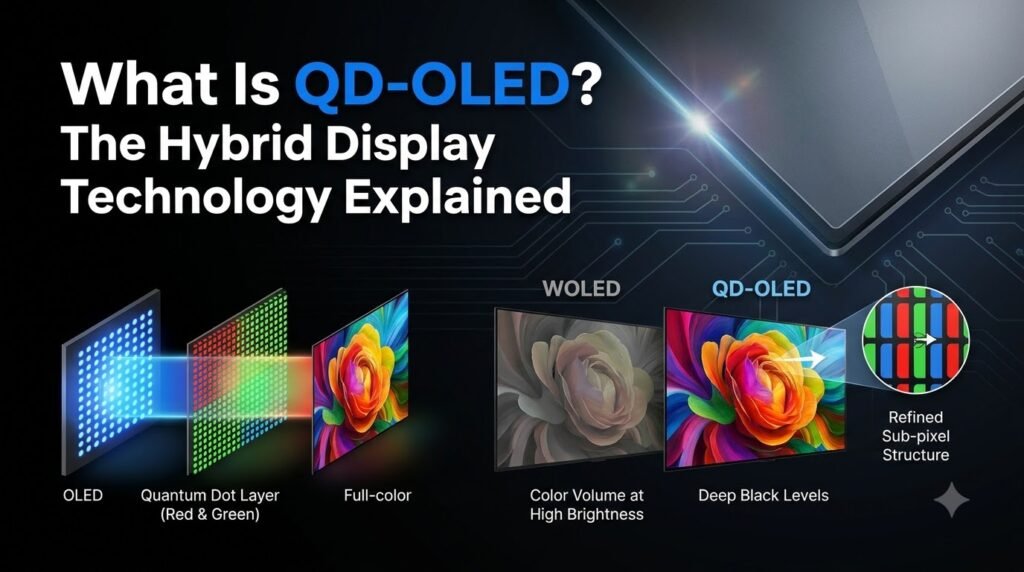
Just when you thought the TV market had finally settled the debate between OLED’s inky contrast and QLED’s blazing brightness, display manufacturers introduced a new contender: QD-OLED.
Developed primarily by Samsung Display and adopted by brands like Sony and Samsung, QD-OLED claims to eliminate the historical compromises of both technologies. On paper, it sounds like the holy grail of displays: self-emissive pure blacks paired with quantum-dot-powered color brilliance and higher peak brightness.
However, if you are looking to spend premium dollars on a flagship television, marketing promises rarely tell the full story. You are likely asking: Is QD-OLED truly a generational leap over standard OLED? What is this controversy surrounding colored fringes on text? And how does it behave when sunlight hits the screen?
If you are looking for an in-depth qd oled explained guide from someone who has calibrated, tested, and lived with these panels through multiple product cycles, you are in the right place. Below, we break down how QD-OLED works, where it fundamentally outperforms traditional OLED, its quirks you must know before buying, and whether it deserves the centerpiece spot in your home entertainment setup.
How QD-OLED Works: Blue OLED Meets Quantum Dots
To appreciate why QD-OLED is a breakthrough, we must understand the fundamental difference in how it produces color.
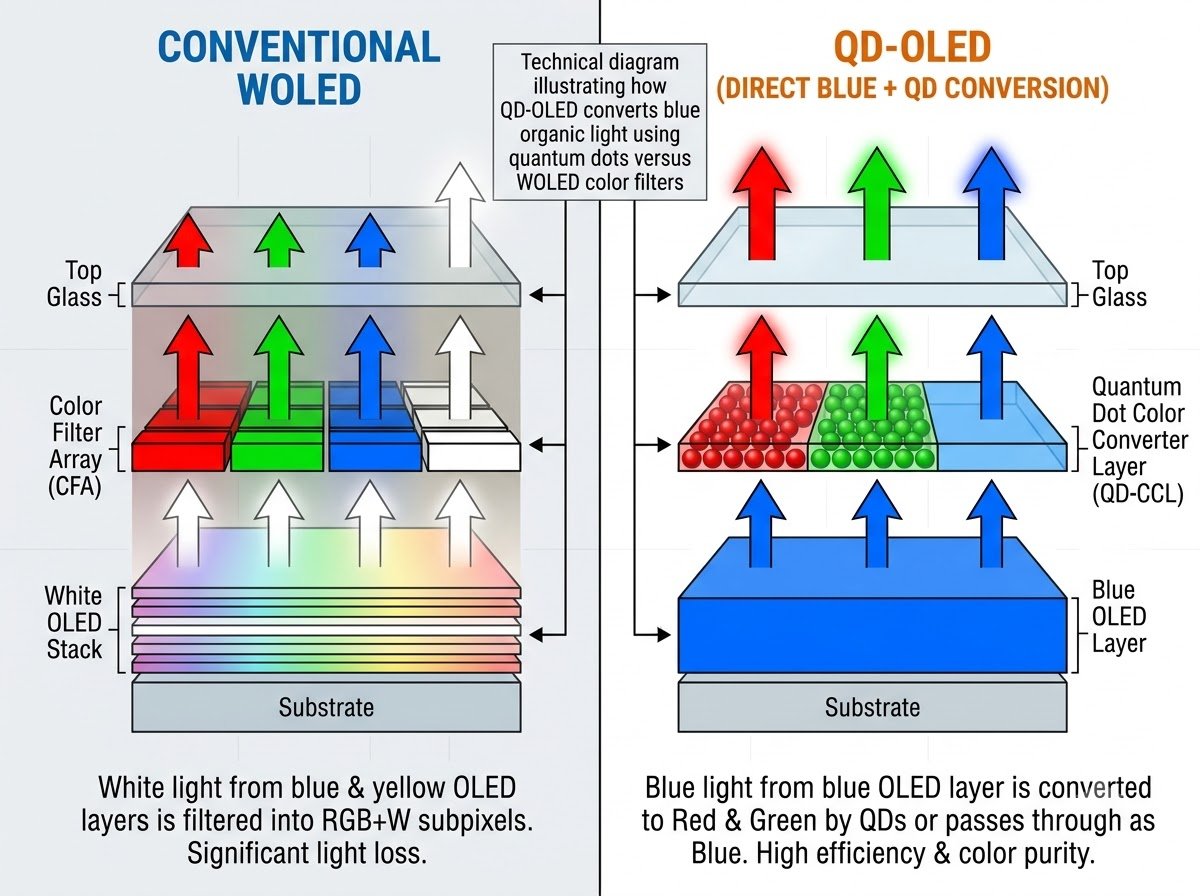
For over a decade, virtually every consumer OLED television on the market was built on LG Display’s WOLED (White OLED) architecture. WOLED stacks yellow and blue organic materials to create a base white light. That white light then passes through color filters to produce Red, Green, and Blue subpixels, alongside an unfiltered White subpixel (WRGB) engineered to boost peak brightness.
QD-OLED (Quantum Dot OLED) throws out that playbook:
-
A Single Blue Emissive Layer: Instead of producing white light, the panel uses multiple layers of self-emissive blue OLEDs. Blue light has the highest photon energy in the visible light spectrum.
-
Quantum Dot Color Conversion: Rather than passing through passive color filters that absorb and waste light energy, the blue light hits an inkjet-printed layer of Quantum Dots.
-
Some quantum dots instantly convert the blue light into pure green light.
-
Others convert it into pure red light.
-
The remaining blue light passes straight through without conversion.
-
Because quantum dots re-emit light with near-100% optical efficiency, there is virtually zero wasted luminance. This elegant architecture delivers true RGB self-illumination without requiring a brightness-boosting white subpixel.
QD-OLED vs. Traditional WOLED: The Color Volume Breakthrough
The absence of a white subpixel is QD-OLED’s superpower.
In traditional WOLED panels, displaying a localized specular highlight (such as a 1,000-nit explosion or a neon sign) relies heavily on the clear White subpixel. While this enables high peak brightness, it introduces an inevitable side effect: color dilution. At high luminance levels, the white light washes out the color, reducing what color scientists refer to as Color Volume.
Because QD-OLED produces 100% of its brightness using pure Red, Green, and Blue light:
-
Rich Color Saturation at Peak Luminance: Bright yellow sunbeams, vivid crimson sports cars, and hyper-saturated sci-fi lasers remain deeply vibrant even past 1,000 nits.
-
Expanded Color Gamut: QD-OLED panels can cover roughly 90% of the ultra-wide BT.2020 color spectrum, whereas standard WOLED panels typically cap out around 70–75%.
-
Wider Viewing Angles: While WOLED already boasts superb viewing angles, QD-OLED takes it a step further. Because quantum dots emit light uniformly in all directions, color tinting and luminance drop-off are virtually imperceptible, even from severe 70-degree seating positions.
Takeaway: In dark and moderately lit viewing environments, HDR content on QD-OLED displays has a visible sense of depth and three-dimensional “pop” that standard OLED struggles to match.
To understand why color spaces matter for HDR mastering, check out our breakdown on Color Gamut: DCI-P3 vs Rec. 709 vs Rec. 2020 Explained.
The Text Fringing Dilemma: Triangular Subpixels
No display technology is without quirks, and QD-OLED’s most discussed compromise involves its subpixel arrangement.
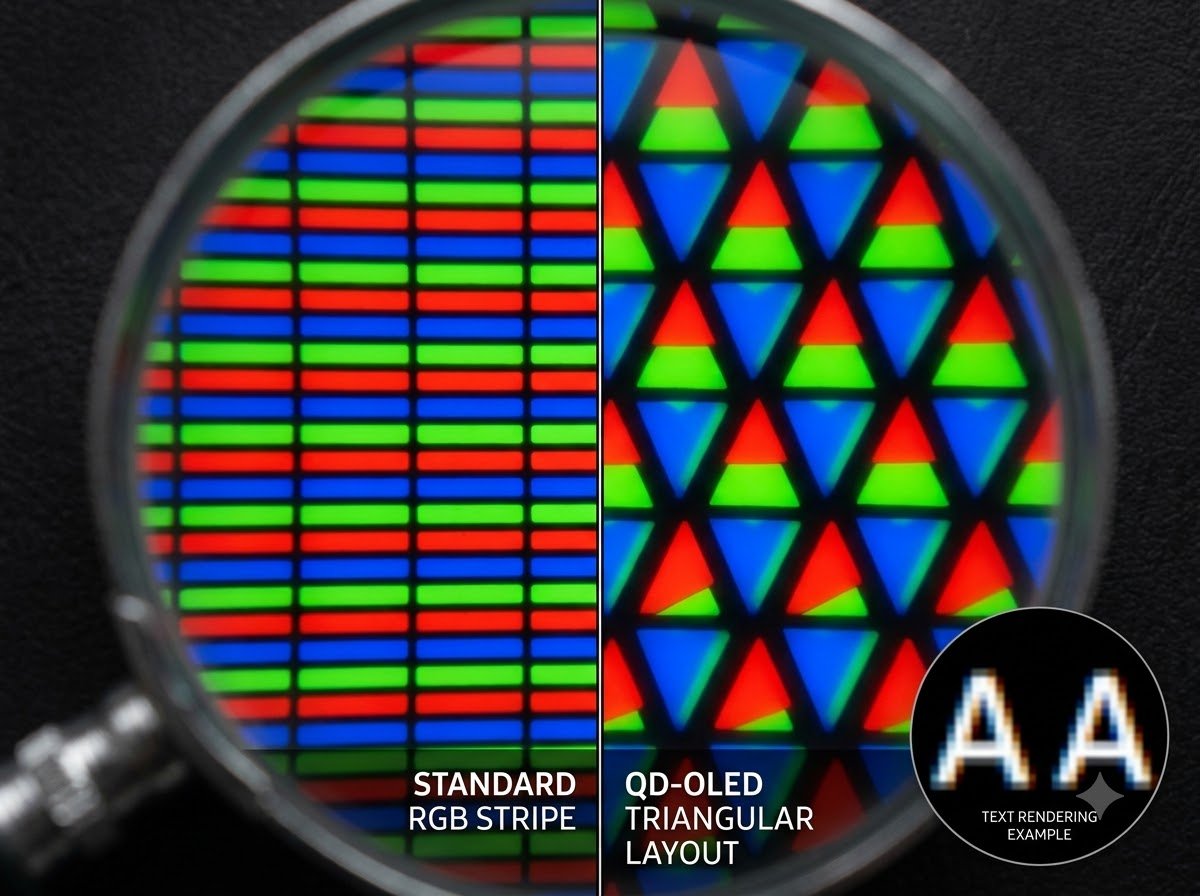
Traditional computer monitors and televisions arrange their subpixels in a straight horizontal line: Red-Green-Blue (RGB). Decades of operating system font-rendering algorithms (such as Microsoft’s ClearType) are specifically tuned to smooth out text based on this horizontal stripe.
First-generation QD-OLED panels introduced a non-standard triangular subpixel layout (Green placed on top of Red and Blue).
Because desktop operating systems do not expect this layout, high-contrast borders—such as black text on a white background, window borders, or sharp computer UI lines—can exhibit subtle color fringing (a faint green border on top and a faint magenta border on the bottom).
Is Color Fringing a Dealbreaker?
-
For Living Room TV Viewing: At standard viewing distances of 6 to 10 feet, the human eye cannot resolve individual subpixels. Color fringing is completely invisible when watching movies, streaming TV shows, or playing console games.
-
For Desktop Monitor Use: If you intend to use a QD-OLED as a close-up PC monitor for text-heavy work (coding, spreadsheets, word processing), you may notice slight soft edges around fonts. Fortunately, second- and third-generation QD-OLED panels feature refined, squarer subpixel shapes that substantially reduce this artifact.
The Ambient Light Quirk: Elevated Black Levels
There is one critical environmental factor every prospective QD-OLED buyer must consider: ambient room lighting.
Traditional televisions use an internal polarizing filter layer to reduce internal reflections. However, because polarizers absorb light and reduce brightness, QD-OLED dispenses with a standard circular polarizer to maximize quantum dot luminance efficiency.
Under direct sunlight or bright overhead room lighting, ambient light penetrates the screen surface and excites the quantum dot layer underneath. This causes dark scenes to take on a faint purplish or charcoal-gray tint, slightly elevating the black floor in brightly lit rooms.
-
In a dark or softly lit room: Absolute, inky 0.000-nit blacks.
-
In a sunlit room with uncovered windows: Blacks appear closer to a high-end VA LCD rather than true OLED black.
Wondering how standard panels handle bright rooms? Read our complete comparison on OLED vs QLED: Which TV Technology Is Actually Better?.
Quick Reference: QD-OLED vs. WOLED vs. Standard QLED
| Display Metric | QD-OLED (Gen 2/3) | WOLED (Standard / MLA) | Standard QLED (FALD) |
| Emission Type | Self-emissive (Blue OLED) | Self-emissive (White OLED) | Transmissive (LED Backlight) |
| Color Generation | Quantum Dot Conversion | Color Filter (WRGB) | Quantum Dot Film + LCD |
| True Black Floor (Dark Room) | Absolute 0.000 nits | Absolute 0.000 nits | Near-black (0.01 – 0.05 nits) |
| Color Volume at High Nits | Class-leading (Pure RGB) | Moderate (Diluted by White subpixel) | High (Driven by backlight) |
| Rec. 2020 Coverage | ~89% – 92% | ~72% – 76% | ~75% – 82% |
| Ambient Light Black Handling | Slight purplish tint under direct light | Excellent (Inky black preserved) | Good (Dependent on anti-glare coat) |
| Burn-in Mitigation | Advanced (Graphene heatsinks) | Advanced (Software & heatsinks) | Immune (Inorganic LEDs) |
Essential Accessories to Maximize Your QD-OLED
To get the absolute most out of a high-bandwidth, high-fidelity QD-OLED television, your peripherals need to keep pace:
1. Control Room Lighting for Flawless Inky Contrast
Because direct ambient glare can elevate QD-OLED black levels, managing natural light transforms your viewing experience.
-
Installing thermal insulated blackout drapery, such as the NICETOWN 100% Blackout Curtains on Amazon, allows you to eliminate daytime screen wash and enjoy reference-grade theater contrast whenever you want.
2. Lock Down Pure 48Gbps HDMI 2.1 Throughput
QD-OLED panels are capable of rendering 10-bit and 12-bit uncompressed 4K HDR at 120Hz or 144Hz. Don’t choke that bandwidth with outdated cables.
-
An officially certified cable like the Cable Matters 48Gbps Ultra High Speed HDMI Cable on Amazon ensures artifact-free, flicker-free transmission from your PS5, Xbox Series X, or RTX graphics card.
3. Clean Without Damaging the Anti-Reflective Coating
QD-OLED panels feature a specialized optical anti-glare finish. Standard glass cleaners with ammonia or alcohol will leave permanent, cloudy discolorations.
-
Keep your panel pristine with an alcohol-free, streak-free formula like the WHOOSH! Screen Cleaner Kit on Amazon, paired with their gentle microfiber cloths.
The Future of QD-OLED: What Lies Ahead?
Samsung Display has continued to refine QD-OLED manufacturing at a rapid clip. Second- and third-generation panels have introduced:
-
Optimized Quantum Dot Formulations: Delivering even higher thermal stability and peak brightness reaching past 1,500 nits.
-
Refined Subpixel Architectures: Sharper text rendering that makes newer QD-OLED panels far more suitable for hybrid PC/TV monitor duty.
-
Lower Degradation Rates: Advanced electroluminescent blue stacks paired with real-time AI thermal monitoring to reduce long-term burn-in vulnerability.
Final Verdict: Is QD-OLED Worth It?
If you are an enthusiast who prioritizes uncompromising picture quality, jaw-dropping color saturation, and cinematic realism, QD-OLED is currently the most exciting display technology you can bring into your home. It solves the color dilution of traditional WOLED without introducing the blooming or haloing inherent to Mini-LED.
Just be mindful of your room layout: position it away from direct, harsh sunlight, calibrate your picture mode, and you will be rewarded with a truly breathtaking home theater experience.
What Are Your Thoughts on QD-OLED?
Are you planning to upgrade to a QD-OLED panel, or are you waiting for prices to drop further? Leave a comment below with your current TV setup and questions—I am always happy to help you dial in the best choice!
Q&A & Discussions (0)