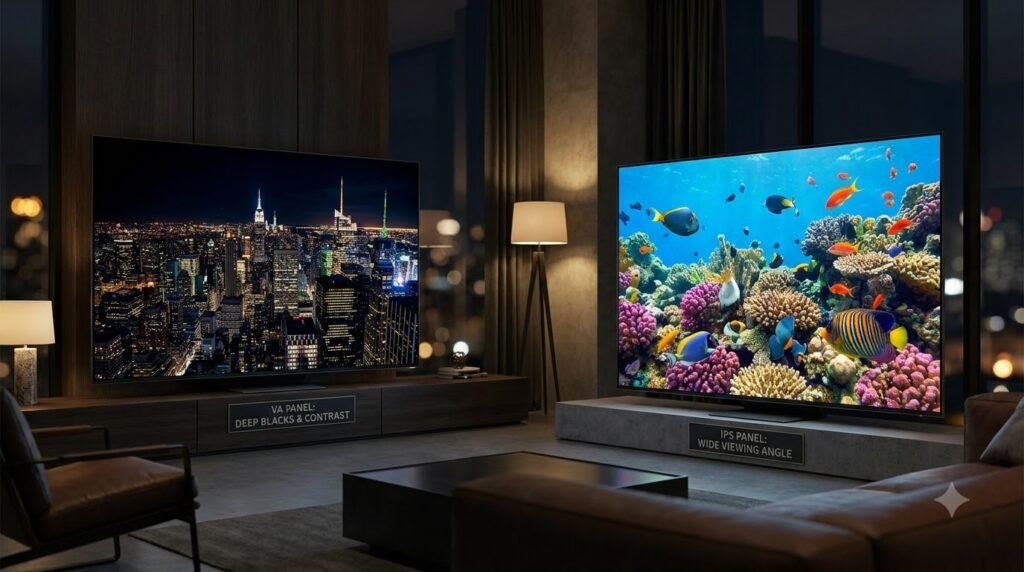
VA vs IPS Panels in TVs: Contrast vs Viewing Angles Comparison
Have you ever settled in for a movie night, turned off the lights, and noticed with frustration that letterbox bars and shadowy scenes looked more like murky dark gray than inky black? Or perhaps you bought a stunning 4K TV that looks breathtaking while sitting centered on the couch, but the moment you step into the kitchen or sit on the corner armchair, the colors wash out into a pale, milky haze?
You are not imagining things, nor is your display necessarily defective. In the vast majority of cases, this dramatic discrepancy in daily performance comes down to a fundamental piece of hardware that manufacturers almost never print on the retail box: the panel type.
When shopping for LED, QLED, or Mini-LED televisions, nearly all LCD screens use one of two core liquid crystal architectures: Vertical Alignment (VA) or In-Plane Switching (IPS) (including its modern variant, ADS).
Understanding the trade-offs of ips vs va panels tv choices is the secret weapon of seasoned AV enthusiasts. In this guide, we will break down the underlying physics, compare native contrast against off-axis viewing angles, share three hands-on tests to identify what panel your TV actually uses, and help you pick the right panel for your living room setup.
Liquid Crystal Physics 101: How VA and IPS Modulate Light
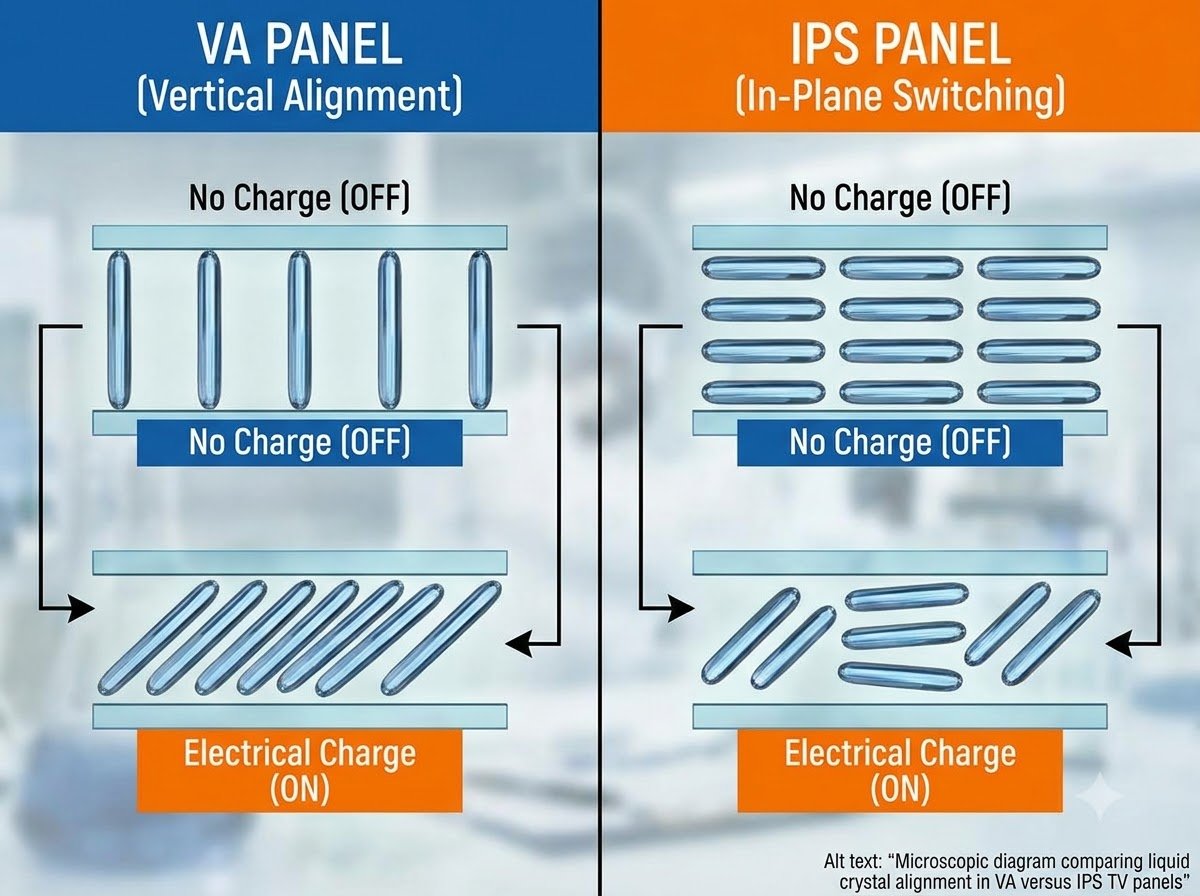
Both VA and IPS displays belong to the LCD family. Neither technology is self-emissive; both require an LED backlight behind the panel to generate light. The liquid crystals act like millions of microscopic window blinds, twisting and tilting to block light or let it pass through color filters to your eyes.
The crucial difference lies in how those liquid crystal molecules are physically aligned and how they rotate when voltage is applied:
Vertical Alignment (VA)
In a VA panel, the liquid crystal molecules naturally align perpendicular (vertically) to the glass substrate when no electrical charge is present. In this default resting state, they form a dense, tightly packed barrier that blocks the LED backlight with remarkable efficiency. When voltage is applied, the crystals tilt horizontally to allow light through.
In-Plane Switching (IPS & ADS)
In an IPS panel (as well as ADS, an advanced derivative developed by BOE), the crystal molecules are aligned parallel (horizontally) to the panel surface. When electrical current is applied, rather than tilting inward or outward, the molecules twist within the same horizontal plane.
This seemingly minor mechanical difference produces vastly divergent visual results in your living room.

The Case for VA: Unrivaled Native Contrast for Dark-Room Immersion
If you prioritize cinematic movie watching, high native contrast is the foundation of realistic picture quality. This is where VA panels claim undisputed supremacy.
1. High Native Contrast Ratio (3,000:1 to 6,000:1)
Because VA crystals naturally block backlight bleed so effectively in their resting state, they achieve deep, natural black levels without relying entirely on software dimming algorithms.
-
A typical mid-range VA display delivers a native contrast ratio between 3,500:1 and 5,000:1.
-
In dark-room environments, space scenes look genuinely dark, shadow details in garments remain distinct, and cinematic letterbox bars blend seamlessly into the display frame.
2. The VA Achilles’ Heel: Narrow Viewing Angles
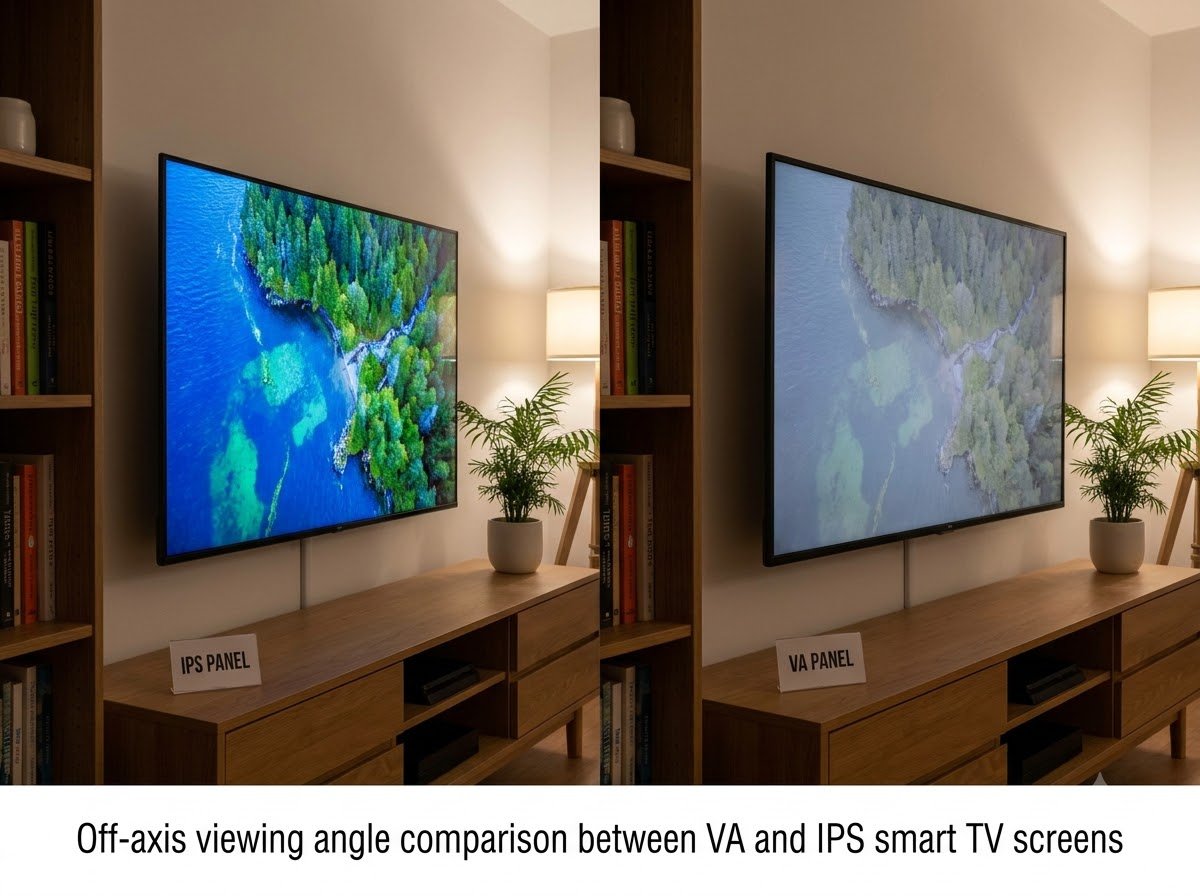
The trade-off for that tight light-blocking seal is directional light dispersion. Because VA crystals tilt forward and backward, light travels through the screen in a relatively narrow cone.
-
Once you move more than 20 to 30 degrees off-center, light begins to leak around the crystal edges.
-
Contrast drops precipitously, dark shadows wash out into gray, and vibrant colors lose their saturation. If you have an L-shaped sectional or seats placed far to the side, viewers on the periphery receive an inferior image.
To see how local backlighting helps LCD panels manage contrast, read our guide on Full Array Local Dimming (FALD) Explained.
The Case for IPS: Wide Viewing Angles for Active Living Spaces
While VA panels cater to the solitary cinephile sitting directly in the center sweet spot, IPS panels are engineered for shared, social entertainment.
1. Wide, Uniform Viewing Angles
Because IPS crystals rotate flat along the plane of the panel, light disperses uniformly across a wide arc.
-
Colors remain vibrant, contrast remains stable, and gamma curves hold true even out to 50 to 70 degrees off-axis.
-
Whether you are standing by the kitchen counter, hosting friends for Sunday football, or watching a party stream from the floor, everyone sees the exact same balanced picture.
2. The IPS Weakness: Low Contrast and “IPS Glow”
The physical orientation of IPS crystals makes it far more difficult to block backlight transmission completely.
-
A standard IPS panel typically manages a native contrast ratio of only 1,000:1 to 1,200:1—roughly one-fourth that of a VA panel.
-
In a dim room, blacks appear noticeably dark gray or purplish. When viewed in darkness, you may also observe a faint silvery sheen in the screen corners known as IPS glow.
How to Test Which Panel Type Your TV Has
Because TV manufacturers often source both VA and IPS panels for different sizes of the same model number (known in the industry as the “panel lottery”), here are three practical diagnostic tests you can perform at home:
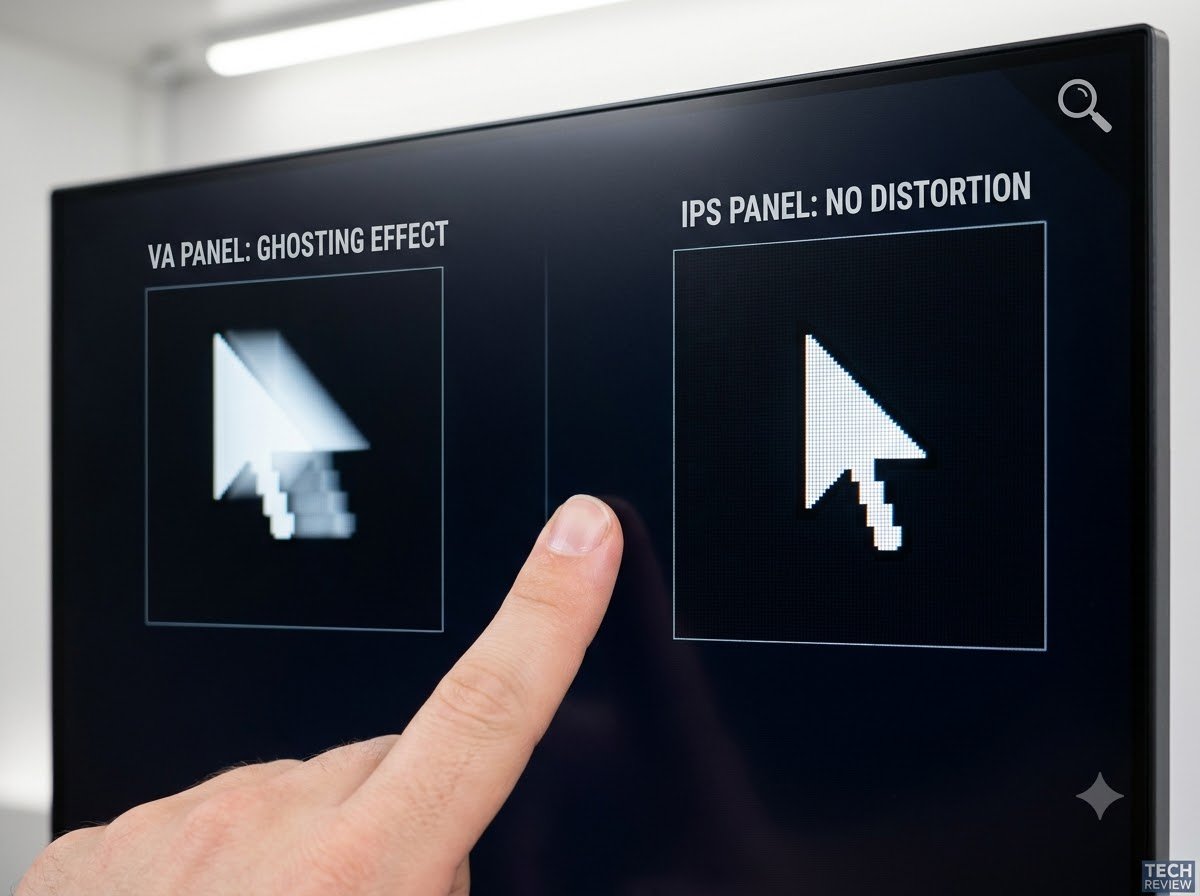
1. The Gentle Tap Test (Pressure Test)
Turn on your television and gently press the screen with your finger (or the eraser end of a pencil) with light pressure:
-
VA Panel: You will observe a brief, localized flash of distorted light or a subtle puddle-like trail around the contact point that fades the instant you release pressure.
-
IPS Panel: The surface remains firm and visually unchanged, showing virtually no discoloration or localized distortion under light contact.
2. The Side-Angle Walk Test
Display an image with rich color saturation and dark backgrounds (like a movie title screen). Sit centered, then slowly walk to the far left or right of the room while watching the screen:
-
If the image loses richness and washes out noticeably within 4 to 5 paces, you have a VA panel.
-
If the colors and brightness remain almost identical until you are viewing from an extreme profile, you have an IPS / ADS panel.
3. The Macro Camera Phone Check
Bring your smartphone camera close to the screen (within 2 to 3 inches) and take a focused photo of a bright white area:
-
VA Subpixels: Typically look like vertical chevrons, arrows, or paired vertical slits (
>>or<<). -
IPS Subpixels: Often resemble chevron-shaped boomerangs or compact rectangular stripes divided into horizontal domains.
VA vs. IPS: Quick Comparison Table
| Performance Factor | VA (Vertical Alignment) | IPS / ADS (In-Plane Switching) | Real-World Advantage |
| Native Contrast Ratio | 3,000:1 – 6,000:1 | 1,000:1 – 1,200:1 | VA (Dramatically deeper blacks) |
| Dark-Room Performance | Inky, rich shadow details | Hazy, grayish dark tones | VA |
| Viewing Angle Freedom | Poor (~20° – 25° sweet spot) | Excellent (~50° – 70° retention) | IPS (Ideal for wide seating) |
| Color Uniformity Off-Axis | Fades and shifts quickly | Highly stable | IPS |
| Pixel Response Times | Fast mid-tones; slow dark-transitions (black smearing) | Consistent, balanced transition times | IPS (Smoother motion clarity) |
| Surface Durability | Softer, sensitive to touch | Rigid, resilient to light contact | IPS |
Wondering how modern self-lit screens bypass this trade-off altogether? Check out our breakdown on OLED vs QLED: Which TV Technology Is Actually Better?.
Room Matchmaker: Which Panel Should You Buy?
Pick a VA Panel If:
-
Your primary viewing happens at night: You love dimming the lamps for movies, Netflix series, and immersive narrative gaming.
-
You have focused, forward-facing seating: Your sofa or theater chairs are positioned directly in front of the screen.
-
You want cinematic HDR depth on a budget: High native contrast gives HDR images three-dimensional punch without requiring multi-thousand-dollar OLED pricing.
Pick an IPS / ADS Panel If:
-
Your living room has wide, dispersed seating: You have deep sectional couches, bar stools, or an open floor plan where people view the screen from multiple angles.
-
The room is always well-lit: If you primarily watch daytime talk shows, children’s cartoons, or sports with overhead lighting or sunlight, the ambient light naturally masks IPS’s lower black level.
-
You need a multipurpose screen / PC monitor: The structural stability and lack of dark-level smearing make IPS panels pleasant for casual PC desktop usage and bright gaming.

Clever Gear to Overcome Panel Limitations
Whichever panel you own, you can easily compensate for its inherent physical shortcomings with a few smart accessories:
1. Fix VA Viewing Angles with a Heavy-Duty Swivel Mount
If you love VA contrast but need to watch from different parts of the room (e.g., the dining table versus the sofa), mounting your TV on an articulated full-motion arm solves the off-axis problem completely.
-
The ECHOGEAR Full Motion Articulating TV Wall Mount on Amazon provides smooth extension and up to 130 degrees of effortless swivel to keep you permanently centered in the VA sweet spot.
2. Boost Perceived IPS Contrast with 6500K Bias Lighting
If you have an IPS screen and find dark scenes washed out at night, placing a calibrated, true-white light strip behind the TV tricks the human iris into contracting. This dramatically deepens your eye’s perception of on-screen black levels.
-
The Luminoodle Color Bias Lighting LED Strip on Amazon plugs directly into your TV’s USB port and significantly elevates perceived dark-room contrast.
3. Maintain Optical Coatings Safely
Both VA and IPS panels feature delicate polarizing and anti-reflective films that can be ruined by harsh household cleaners.
-
Keep a safe, ammonia-free cleaner like the Mistify Screen Cleaner Kit on Amazon nearby for fingerprint and dust removal without micro-scratches.
Final Thoughts: Finding the Right Balance
In the debate between ips vs va panels tv setups, there is no universal “best” display—only the best display for your specific room and lifestyle.
If you want the intimate, immersive contrast of a movie theater and sit straight ahead, VA is the clear winner. But if your television is the social hub of a bustling, brightly lit living space where everyone gathers from every angle, IPS remains a dependable, versatile performer.
What Is Your Setup?
Did you run the tap or walk test on your TV? Tell us what panel type you discovered in the comments below, along with your living room layout—I will happily offer tips on how to calibrate it for optimal picture quality!
Q&A & Discussions (0)